
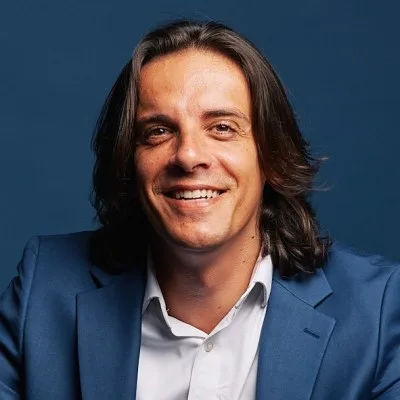
02 · The guest
Eman Pulis
Founder, SiGMA Group
Eman Pulis is the founder of SiGMA Group. He launched the first Summit of iGaming in Malta in 2014, after a failed partnership left him in debt, and built it into a global events and media business with shows across Europe, Africa, Brazil, the GCC and Asia, and offices from Malta and Limassol to Manila, São Paulo, Belgrade and Yerevan.
Emily Micallef has been CEO of SiGMA since 2023. Eman remains the founder and public voice of the group, and is General Partner of Ikigai Ventures. He launched the SiGMA Foundation during COVID, and calls it the project that fulfils him most.
Connect with Eman on LinkedIn →03 · In this episode
Moments worth queuing up
In their own words
“If there’s one thing I’ve learned from all these experiences, it’s when shit hits the fan, just zoom out. It’s not that bad. Focus on the bigger picture, focus on the long term.”
“I have yet to see a successful man who can stand on his own two feet who hasn’t gone through hell.”
“If I look after my team, they look after my business.”
“Business is not done between the brands. Business is done between people.”
“Time is extremely important, and unless you do the right decisions at the right time, you end up living with regrets.”
“What would I pay thirty years from now to listen to that voice again and to give them my time?”
Key takeaways
What to take back to your desk
Rock bottom can be the starting point. SiGMA came out of €16,000 of debt from a failed partnership. Eman still invoices through Viking PC Health Limited, the company that nearly finished him, as a reminder of where he came from.
Plan for what comes after the exit long before it happens. Very few founders are ready for any stage of a business, and the question that matters afterwards is not cash but what will make you happy.
When everything collapses, zoom out. Focus on the long term and clock small wins. Six months of small wins will show you how far you have come, and it keeps you sleeping at night and your team sane.
You cannot expect your team to have a founder’s mindset. They chose not to be founders. Be in the trenches with them, pick up the piece of paper yourself, and look after them as people. They will look after the business.
Losing a battle is not a reputational risk. Losing your moral compass is. Take calculated risks, learn from the bets that go wrong, and keep the mission clear.
Time does not wait. A sale that falls through can be the best thing that happens to you: SiGMA was about to sell at X and is now worth 5X. The chapters with your children do not come back.
Full transcript
Read the full transcriptHide full transcript
Eman: Probably the biggest conundrum that I have now is whether I'm giving too much time to the business versus more time to the foundation. Looking back, do I want to be in a position where I say, "Man, I could have impacted a million more people. Instead, I focused on generating another million euros"? I didn't do my homework. I didn't do my due diligence on this partner, who later on ended up really, really badly. Left me with debt with the bank. Doesn't seem much today for me, but back then it was world-crushing. I received this email that the acquisition, despite being in the last stage, it was prudent to pull back. We were about to sell a business at X. Today it's worth 5X. If there's one thing I've learned from all these experiences, it's when shit hits the fan, just zoom out. Focus on the bigger picture. Focus on the long term. My kids are five and eight, and whenever I hear them calling me Papa, immediately what comes to mind is what I would pay 30 years from now to listen to that same voice reaching out to me. What would I pay? They're not gonna call me again that way. They're not gonna come to me the same way they come now. So whenever they come to me, and either I'm working, I'm on my phone, I'm speaking to my wife, whoop, drop everything, and it's just them.
Leo: Welcome to The iGaming Leader Podcast. I'm your host, Leo Judkins, founder of the iGaming Leader Mastermind, and on this show I sit down with some of the most inspirational leaders in our industry, diving into real challenges, high-stakes decisions and lessons that shape our industry. If you're a VP, director or C-level executive in iGaming, this podcast is built for you. Before we dive in, a quick thank you to our sponsors, Sumsub and Bloomreach. Sumsub is the full-cycle verification platform trusted by top iGaming operators worldwide. Sumsub helps operators onboard players quickly, stay compliant and prevent fraud, all without slowing growth. And Bloomreach is the AI platform for marketing automation used by leading iGaming operators, turning player data into real-time engagement that strengthens retention and loyalty. More information on both in the show notes and in the description. Let's dive in.
Leo: A quick note before we start this video. The recording with Eman was amazing, he had such great answers, but for some reason the video on my side didn't work very well. There's stuttering in this video because I've got a new camera and I clearly hadn't set it up correctly. I didn't want to re-record because his answers were amazing, so I'm going to leave it. Hopefully you can see through it. Of course, you can just listen to the podcast. It's also available on Apple or on Spotify, so if you prefer to listen to it there, you can. Without further ado, welcome to the iGaming Leader Podcast. Enjoy, Eman.
Leo: Hey, everybody. Welcome to the iGaming Leader Podcast. I am here with Eman Pulis from SiGMA. Eman, really great to have you here on the podcast. How have you been?
Eman: I've been great. There's never a dull moment, right, in this industry. You've seen what's going on in Brazil, in Curaçao and the rest of the world. So never a dull moment.
Leo: It has definitely been the topic over the last few weeks for everybody. A while back I had Alex Tomic as an expert speaker, and he said, "Man, Eman travels even more than I do. He's even busier than I am." Would you agree with that?
Eman: I think so, and I love it. I love my job. I am eternally grateful for the life that I'm living, quite honestly. I'm genuinely so happy with the life that I have. And I look back 10 years ago, 12 years ago now, at how much I was willing to sacrifice to be where I am today. When I used to go to the first conferences, knocking on 50 doors, I was lucky if one of them gave me the time of day to listen to my pitch. And today, people are happy to listen to me, to talk to me. People want to talk to me, even. So I never forget the beginnings, how tough they were. And for me to want to stay home and not travel now, when I've worked so hard to be at this point, where people want to meet me, people want to have meetings with me, it would be foolish.
Leo: It's exactly that, right? Every successful founder and CEO that you speak to, just like yourself, talks about the same thing. It's hard work, it requires dedication, and there are no shortcuts.
Eman: I honestly rarely understood why people, once they've made it, decide to take a backseat and not travel anymore. I think it's so much more fun to travel when people recognise you, when people want to talk to you. I still have some fire in me, and I don't plan on slowing down.
Leo: Maybe it's different after a potential exit. You see so many founders who, with an exit, face some sort of existential problem. What is my purpose now as a founder, and where does all this time go? I think it's a really difficult question that you almost have to answer before you actually go through the whole exit and earn-out.
Eman: Look, when you come up with an idea, when you launch a business, when you scale a business and when you exit a business, very few people are ready for any of these four stages. Probably the only difference is that when you're exiting a business, you have better acumen of what you should be doing. So my biggest advice would be to always prepare yourself for what comes after, way before. And I think it's something which I try to practise, not just by preaching, but by actually planning. We have a very clear plan of where we want to take SiGMA beyond 2030. That was already seven years ahead of our time when we came up with this plan. But on a more personal level, it's also very important to identify what's going to make me happy post-acquisition. And I think I do have a plan for that, if and when the time comes.
Leo: That is the ultimate question, right? It's never about cash, it's always about happiness. If we need meaning in life, that is the meaning in life. I remember the first time I reached out to you, Eman. I'd seen a video of you bringing a bunch of Maltese ministers around the SiGMA floor, and I said to you, "Look, we really miss that in Gibraltar. We've got all these big PLCs here, but there's nobody really doing what you've done for Malta." And one of the things you said a while back in an interview is, "SiGMA's made Malta, Malta's made SiGMA." Since then you've moved the flagship to Rome, of course, and you've moved off yourself as well. So my question really is, what does Malta still get from Eman Pulis?
Eman: I am eternally grateful to Malta. I am where I am today because Malta had the foresight to regulate iGaming before many others, back in 2001. I am where I am today because Malta created a robust financial services network for the industry to move here and find a safe space. Malta created the ecosystem that made me who I am today. So I am eternally grateful. And we're not leaving Malta. SiGMA will never leave Malta. Even if I have to leave to build the business and make sure it remains robust. I've done this plenty of times. I did it as a student, to get the best knowledge I could get. I did it as a young entrepreneur when I moved to the United States, to learn from the land of opportunity. I did it when I moved to the Philippines later in life to set up a gaming hub for SiGMA. And I did it more recently in Limassol, so we can be active in the heart of where the Slavic community is, and where the Israeli and Jewish community is too. That's why we have such a heavy presence in Limassol. But let's not forget, we have big offices in Malta. We employ over 100 people in Malta. We have a conference happening in Malta this coming May, and we have zero plans on moving the show out of Malta. I think people still see that SiGMA is very much tied to the island. Even our DNA has a lot in common with Malta. So we look forward to being in Malta every year, and we look forward to keep strengthening our office in Malta. So what do I have to give Malta? I think there's a lot of fuel left in the tank.
Leo: I think you've made such a difference to the country, and you're an example to so many there as well. Anybody that goes beyond the borders is an inspiration to so many young entrepreneurs, because sometimes when you're in a place you can feel stuck and you can think, "Oh my God, I'm never gonna leave this place." And I think that's beautiful.
Eman: 100%. I feel I can give so much more to the local business community, to young entrepreneurs who need someone to look up to, which I didn't have. I didn't have a lot of Maltese entrepreneurs who I could look up to and emulate. And being abroad, I can wave the Malta flag wherever I am and bring with us as many Maltese entrepreneurs as possible to expand their businesses. If you come to Rome, you're going to see hundreds of Maltese doing their thing, whether it's booth build-up, sound, electricity, catering, entertainment, music. Hundreds of young Maltese entrepreneurs who are given the opportunity to expand beyond their comfort zone in Malta. So if you ask me, I think I have a lot more to provide to Malta by doing my thing abroad. The world is a global village.
Leo: I love it. I want to talk a little bit about Emily. She's been CEO since 2023, and you've said something like, "The show can easily run without me, and a business that can't run without you is essentially a hobby." I completely agree with you. But you don't really have an office. You sit in a chair in an open plan, and you're on a plane more than Alex, like we were saying. So what is it for you now? Is it still running inside the business? Is it more being the face of the company? How do you see your involvement in SiGMA itself?
Eman: I will always remain the founder who loves his business, and I am still involved as a voice for the project. As I told you, I still love travelling. I love people. I still love meeting people. So I have more of that role, rather than an executive one. But there's other stuff that keeps me entertained in my entrepreneurial journey. There's a VC fund which I launched four years ago, and I'm very proud to have some of the brightest minds as LPs in this fund. And something that gives me even more satisfaction than the fund or the events is the SiGMA Foundation. It's something which I launched in the midst of COVID, and looking back, I'm really happy that I did. Rather than focusing on just trying to keep a sinking ship afloat, because remember, there were no events happening during COVID, that is the time when we took the initiative to launch the SiGMA Foundation. We had a bit more time on our hands, and the idea of thinking about others, focusing on positive impact and building something which has a long-lasting effect fulfils me more than any other project.
Leo: With the fund, it's Ikigai Ventures, right? It's like the Japanese overlap between purpose, what you can get paid for, what the world needs, and the last one I forget. Is that why you named it that?
Eman: Correct. One, I'm a big sucker for Japanese culture. I think they got it right many, many times, and we should look outward sometimes for answers. And yes, Ikigai hits four things. If you hit those four, you have found your Ikigai. If you're good at something, if it pays you well, if you love doing it, and if it's great for society, if you're doing something good for the world. And we want to invest in founders that have found their Ikigai. So whenever we have a project coming to us, we filter it through this metric, and we have been able to secure some really nice projects with that mindset.
Leo: I want to go into that, because I love how you do these things with business names. Every company in the industry that works with you guys gets invoiced by Viking PC Health Limited. For me it was the other way around. I got paid by it when we did some work together.
Eman: You did feel it's a weird name, right?
Leo: It was super weird. And it's the business that nearly finished you, and you said you'll never change the name until you actually exit. What does it do to you to see that every day? Can you tell the backstory a bit? Is it a reminder?
Eman: Bit of a rewind. I was desperate to see a business flourish. I had just returned from the States, where a business failed. I was on my second, third failure already. And a guy approaches me, and we launch this affiliate company to sell a white-label antivirus software called Viking PC Health. So we had this company which we launched together, Viking PC Health Limited. I didn't do my homework. I didn't do my due diligence on this partner, who later on ended up really, really badly. Left me with many problems, left me with debt with the bank. Maybe sixteen thousand euros of debt. It doesn't seem much today for me, but back then it was world-crushing, because you have no sources of revenue. The bank calls you every other day. And when that is your first experience, it hits you hard. So I remember thinking, "Listen, I can't be doing this if I'm not an expert affiliate, if I don't know how to run an antivirus software. Let me go back to the basics, to what I do best, which is events." The idea of SiGMA came out of that rock-bottom moment. And I remember going to the bank and telling them, "Listen, I know there's this debt, there are a few months of late payments. Let me turn things around. I plan on launching this summit, the summit of iGaming in Malta." That's why the acronym SiGMA. And the rest was history. The event was successful from year one, and I said, "Okay, the worst nightmare of my life is over. Do I want to bury it?" I said, "No, it can remain a constant reminder of where I'm coming from." So that's why I decided to keep the name. And now a multi-million, nine-figure business is invoiced by Viking PC Health.
Leo: It's funny how the things that you look back on now are tiny, but they felt just as painful, right? Probably more painful, even. Here's a good question for you. If you transported yourself back in time to that moment, do you think you would have dealt with it the same way? From a stress perspective, how to get out of that situation, how to deal with the bank. Given the same resources as then, but the mindset that you have today?
Eman: You know what? I love this question. But I would just tell a younger me, "Just keep going. You have the right mindset, just keep going. Just trust the process." I wouldn't want to take away any of the stress, any of the life lessons that came along with the pain. Because I'll tell you one thing: I have yet to see a successful man who can stand on his own two feet who hasn't gone through hell.
Leo: Yeah, 100%.
Eman: So would I want to take away any of those lessons which kept me awake at night? I don't think so.
Leo: As a father, I think about it a lot as well, because obviously we want the best for our kids. We also know that those moments of deep, profound stress and shame are the fuel to create the person that we want to become. So how do you balance that as a dad?
Eman: Biggest conundrum. And those are the conversations, maybe over a cigar, I enjoy having the most, with men older than me who have kids older than me. I see their kids and I see how incredibly bright they are, and I tell them, "But they lacked nothing, right? How did you manage to give them everything and raise them so capable at the same time? How?" I love asking these questions and listening to what they have to say. Those are the conversations I enjoy the most.
Leo: Well, let me know when you find out the answer. I'd love to know as well.
Eman: Yeah.
Leo: Eman, you put a sales dashboard in every office, so that when Dennis in Cyprus closes a deal, Manila knows it in real time. Obviously my business is way smaller than yours, but we all know as founders and owners that nobody's gonna be as driven as you. You've said it as well: you've got to give up on that fallacy when you're an owner. What are some of the difficulties, and some of the successes, that you've had with handing over the company to people that you believe are never gonna care as much as you will?
Eman: Let's start from the screens. We're probably the only truly global gaming events and media business, because we have a summit every six weeks, more or less, and we try to cover the globe. We have the number one summit in Africa, the number one summit in Brazil, the number one show in the GCC, the number one show in Asia, the number one show in South Asia. And we have offices, actual boots on the ground, in all those regions. We have an office in Manila, an office in São Paulo, an office in Belgrade, an office in Yerevan. And how do you keep all this workforce together, with the different cultures and customs that come with it? We try to implement these little features that help bring the offices closer together. One of those features is, if a sale is happening in Manila, I want the rest of the team to celebrate that. If a sale is happening in Brazil, I want the rest of the team to celebrate. So we have live action going on on each of those screens in all the offices. We're close to five hundred people now at SiGMA, and I see that having such a diverse team is a very important ingredient to becoming truly global. You can't have an office in Malta and expect to have successful shows all around the world. You need local people to understand the way business is done in each of these localities. So it wasn't easy. We learnt a lot by doing, but we did put our best foot forward. I remember when everyone was focused on going to the US, when there was this big craze of the US market opening up and more shows started appearing there, we said, "Listen, there are great events happening in the US. I don't think we're going to provide extra benefits by trying to compete with that and opening a new show in the US. Let's go to the rest of the world." And we launched shows in Brazil, in Dubai, in Africa, in Manila. And we did it the way it should be done, I think, before many others.
Leo: And the second part of that question, Eman. What do you find hardest, and what have you tried to get people to have the same level of urgency and importance? I think as founders we all recognise that's something that's impossible to fully achieve. Of course, we have people that are high performers and high achievers, people that really care, but there is always a gap. So what are some of the things you've tried, and some of the things that have worked for you, to get people more involved and more passionate?
Eman: Two things come to mind. One, I like to be in the trenches with the team. There's this caricature that always keeps coming to mind. Rather than being on a platform, pointing fingers and telling people what needs to be done, I like to be in the trenches and actually doing it myself. And I always use this silly example. If I'm at the expo at SiGMA, walking down one of the corridors, and I see a piece of paper, I pick it up. And when my team sees me doing that, they're gonna feel, "Okay, if he's doing it, I should be doing it," without excuses. So I love to be in the trenches with the team and get my hands dirty. The other thing: I love people. To me, the team is not a team that I see nine to five, and that's it. I invite the team into my space at home. I love to understand what's going on in their lives, if there are any troubles that I can help them with. If I look after my team, they look after my business. I cannot expect them to have the same founder mindset, because they chose the route not to be founders. They chose the route to help me build my business. But the more attention I show, the more care I show to the team, the more comes back at you, in ways that I cannot explain.
Leo: It's the same discussion that you would have with any sort of B2B provider, right? It's never about the headlines and the marketing. It's always about person to person. That's how we do business, and leadership is exactly the same thing. It's person to person, not boss to employee.
Eman: I'm a strong believer in that. Not just with my team, but even with the industry. Business is not done between the brands. Business is done between people. And I think that's something which we take pride in with SiGMA. We try to create this environment. In fact, I hear it from a lot of people. They tell us that SiGMA feels more like a place where it's friendship first, and business will follow automatically. And I think SiGMA embodies this more than anything.
Leo: Yeah, makes a lot of sense. I want to take you back to your wedding. December 2019, in Phuket. You've got 20 guests at your wedding, and an exit in advanced stages, hanging on due diligence. But two weeks later it's gone.
Eman: Correct.
Leo: Take me back to that moment. And when you look back at it now, is that relief or grief for you?
Eman: I think it's the greatest silver lining ever, looking back. But I do remember December 2019. I'd just gotten married, and I'm sitting on this porch in front of a beach in northern Phuket, looking at this perfect moment. Just got married. My family and her family are around me. And I'm thinking, "It's just too perfect. Something's gonna happen. It can't be this perfect." And COVID was already brewing in Asia, but in Europe we thought, "Okay, it's just another news story in Asia." A couple of months later it started hitting Europe, and all businesses started contracting fast. And before you know it, I receive this email that the acquisition, despite being in the last stage, it was prudent to pull back. Which I obviously agreed with, because I didn't want my three-year earn-out to be plagued by COVID. So March, April, May weren't a pleasant time, until we figured out how to navigate the way forward. Those were two heavy months. But looking back, we were about to sell a business at X. Today it's worth 5X.
Leo: But it must have been horrible in that moment. Let's go back to the discussion we just had, about the 16K situation that really formed you and defined you. That situation around your wedding, with the deal falling apart in due diligence: what changes did it cause in you, if any? Did it give you a new turbocharge? A point to prove? What did it do?
Eman: If there's one thing I've learned from all these experiences, it's when shit hits the fan, just zoom out. It's not that bad. Just zoom out. Focus on the bigger picture, focus on the long term. When the whole world collapses on you, which happens to everyone, it's how prepared you are for those rainy days, and how consistent you are: "Okay, I'm at the lowest point in my life. How do I execute small wins?" And after six months of clocking in small wins, you look back and you'll be like, "Okay, I was in a much worse position six months ago. I just need to hold on and keep going at this pace." I've learned this the hard way. I learned it when my partner betrayed me. I learned it the hard way when COVID had other plans in mind. I've learned it through other experiences. Now, when I'm faced with the same situation, where I feel shit is about to hit the fan, I just zoom out. And I find it extremely helpful to manage stress, to sleep well at night, to keep my team sane. You can only get that from experience. No textbook is gonna give you that.
Leo: It's kind of the founder's curse, I often think. We don't really celebrate the wins. The wins are over in a second, and the problems hit so hard. They're so painful. It's a disproportionate seesaw, I think, for most of us. Then over time you seem to get a little bit numb to the challenges, because you have to deal with them every single day. And the worst ones hit you because you're top of the tree.
Eman: Correct. It can get lonely up there, if it's not managed well. But I think it's one of the greatest blessings to be a founder running a successful business, where the lives of others, quite literally in our case with the foundation, depend on the decisions that you make. And there's another thing I'd love to highlight. Coming from very humble beginnings, literally from a poor family, it gives you incredible joy to wake up every morning and know that your loved ones are enjoying a better life because you were the one who went the extra mile, who burned the midnight oil, to get his family out of poverty. That is an accolade which cannot be measured by any means, but it's one that I cherish, and I wake up every morning feeling blessed and thankful for that opportunity.
Leo: I love that, Eman, because you are also the crazy one, just like every founder. The one that believes for long enough in the thing that everybody else tells you is not gonna work. Looking back now, of course, you're right, but you could have been wrong, and they could have been right. You just bite through long enough. You said something about loved ones starting to doubt you at 32, which is literally the thing every single founder goes through. I personally believe successful founders are always the ones crazy enough to believe in their vision for longer than anybody else. In that journey, who were the loudest in believing and disbelieving in you? And have you ever told the ones that doubted you that they were wrong? Or have you left them to the past?
Eman: No, those who doubted are still very much a big part of the inner circle, because I know their doubts were coming from a good place. So absolutely no grudges there. Quite the opposite. Even those who believed in me until the very end told me at one point that I should get a full-time job. So even there, I had people who started doubting, and you can't blame them. I'm in my early 30s, I've never had a proper job, I've been chasing my dream for 15 years. You can't blame them. And the fact that it took so long, I think, makes it even more beautiful.
Leo: You said that the one thing that costs you sleep is reputational risk. I was in the tank with Alex Tomic on Thursday, in Lisbon, and we were talking about that. We all know it takes forever to build a good reputation and just a moment for it all to break down. How is that for you? You've taken some massive bets on where to put conferences, where to go in the industry. The industry follows you, but sometimes it turns out to be the wrong decision. How do you deal with that? Do you feel that's a reputational risk, or is it just a business decision that's gone wrong?
Eman: Look, there's a difference. I'm a big fan of taking calculated risks. Not risk for the sake of risk, because that becomes gambling. But I am a big fan of taking calculated risks, and it doesn't matter if you lose battles. What matters is that you win the war ultimately. So yes, we might have gotten some projects wrong. But there are always lessons to be taken from that. There are always wins that you can take and pivot towards the bigger goal. And today, SiGMA has a clear mandate. We're not here just to organise events for the sake of networking. We're here to advance regulated gaming worldwide. We're strong believers that regulation is the way to go, and I think there's still a lot to be done in emerging markets to push this mantra, whether it's in LATAM, in Brazil, in the GCC, in Africa, in Asia, in South Asia. That's why you find us in those markets. So the mission is crystal clear. Whether people tell us, "No, you should go there instead of there," is insignificant. You were talking about reputation and damage. I think that's a much bigger issue than merely taking the wrong turn on one of the thousands of business decisions you have to take daily. It's not having the moral compass to do the right thing, not being guided by values. That, and letting down that inner circle I was talking about, would be devastating.
Leo: I get that reputational risk keeps you up at night. That's the thing we all worry about, because that's all we really have when it comes to business. And you are guided by your values. You are a family man. You will not let your inner circle down. So there's a tension between those two things. Why is that tension there, do you feel?
Eman: Very often I feel that time is on our side, but it really isn't. I see people my age who stayed a bit more comfortable in their teens or their twenties or their thirties, and they missed the boat. The ship has long sailed. And this can happen at every stage in life. You're young and you could have become an Olympian, but you didn't put in the hours of training. Now you're in your twenties and that opportunity is lost forever. You can't reclaim it. You could have studied a bit harder and had a better career; now you're in your forties and that ship has sailed. You could have started a family earlier on, but you preferred to stay partying, doing drugs, chasing women. Now you're in your late forties and you feel it's too late to start a family. So time is extremely important, and unless you do the right decisions at the right time, you end up living with regrets. I do see my life in this zoomed-out way, and I wonder whether I'm gonna look back and regret not doing stuff until it became too late. I'll give you a silly example. My dream is to catch a big marlin. It's one of my dreams. And I need to do it before I'm in my 70s or 80s and become too frail to pull that marlin out. I don't want to become too frail for the dream to just be gone. I still want to do everything that I set out to do. And probably the biggest conundrum that I have now is whether I'm giving too much time to the business versus more time to the foundation. Looking back, do I want to be in a position where I say, "Man, I could have impacted a million more people. Instead, I focused on generating another million euros, rather than impacting a million people positively"? These are the kinds of questions that keep me entertained when I'm smoking a cigar.
Leo: Yeah, I love it. There's a great book that's all about deathbed regrets, where they interview people about the regrets they have as they're dying of old age. I think that's really inspiring. And there's another one called Four Thousand Weeks, all about how long life actually is. Two books you might be interested in.
Eman: Look, I do it all the time. I'll give you another example, and every parent will understand this. My kids are five and eight, and whenever I hear them calling me Papa, immediately what comes to mind is what I would pay thirty years from now to listen to that same voice reaching out to me. What would I pay, thirty years from now? I'm in my seventies, they're in their thirties. They're not gonna call me that way again. They're not gonna come to me the same way they come now. They're not gonna want to hold my hand the same way they want to now, when I'm their role model, their hero. Or I hope they will. But what would I pay thirty years from now to listen to that voice again and to give them my time? So whenever they come to me, and either I'm working, I'm on my phone, I'm speaking to my wife, whoop, drop everything, and it's just them. Because this thought of what I would pay thirty years from now is a constant reminder to also live in the present.
Leo: Beautiful, Eman. I love that. I saw that you also told your daughters on camera, "I hope I will not embarrass you, disappoint you, or let you down." I think that's beautiful.
Eman: The kids do help you stay in the lane, if that makes sense. Everything you do is a lot more meaningful, because you're not doing it just for yourself. You're doing it for them as well.
Leo: And it shows you that time is actually quick. In our 30s and 40s, you don't realise how quickly time goes. But then you've got kids, and all of a sudden they're walking, and then they're talking, and then they're in university. And all you did was blink.
Eman: And time doesn't wait for anyone. I love talking about kids. They're babies for a year, toddlers for three years. They're kids for seven, eight. They're teenagers for five. All four stages are incredibly beautiful, and they all give you something unique. So as a parent, you have no time to miss the previous phase, because now you're busy loving the next phase. You don't have time to miss them being babies. You don't have time to miss them being toddlers. You don't have time to miss them being kids. But at the age of seventeen, eighteen, when they leave the house, it all hits you at once.
Leo: Very last question for you, Eman. As a founder at 35, with 200 people, you were making every big decision alone. You said you wish you'd begged for mentors. Other founders who are maybe in that same situation, scaling a business and making every decision alone: who should they call, and what should they ask? How should founders go about it?
Eman: Look, I come from a different era. When I was a teenager, we didn't have the social media that we have today. We weren't as connected as we are today. So to anyone who's dreaming big, what I can tell them is: don't shy away from reaching out, by whatever means, to someone you look up to. In business, there are plenty of extremely successful people out there who are within reach, on social media, on LinkedIn. Do take the plunge, because there are many founders out there who understand that. Founders who are successful, who have made it, who understand the importance of giving back, of giving others the opportunity to shine. The startup pitch is one of the things I cherish most at SiGMA, because it gives me an opportunity to see young founders who are trying to build something. So that's what I would say. Take the plunge. Don't shy away. The world is better connected than ever before, and there are many role models out there you can emulate.
Leo: Eman, thank you so much for your time. This has been absolutely brilliant. Thank you for sharing your stories.
Eman: It's been a pleasure, and I look forward to welcoming you with arms wide open in Rome.
Leo: Rome, here we go. See you soon.
Leo: Thank you for listening to the iGaming Leader Podcast. If you're a VP, a director, a founder or a C-level executive in iGaming and you're making the biggest decisions all alone, you might want to check out the iGaming Leader Mastermind, a programme I've built with small inner circles of vetted senior executives, where we run weekly hot seats and you get accountability from people who understand the effect of the decisions that you need to make. Find out more and apply at igamingleader.com. And a final thank you to our sponsors, Sumsub and Bloomreach. Sumsub is the full-cycle verification platform for iGaming operators, covering player onboarding, AML and fraud prevention, all in one place. Bloomreach helps operators turn real-time player insights into more personalised engagement that builds long-term loyalty. More at sumsub.com/gambling and bloomreach.com. See you next time.
This episode is brought to you by

The full-cycle verification platform for iGaming operators. Player onboarding, AML and fraud prevention, all in one place.
sumsub.com/gambling

The AI platform for marketing automation used by leading iGaming operators. Turn player data into real-time engagement to deliver timely, relevant experiences and strengthen retention and loyalty across every touchpoint.
bloomreach.com/igaming
Related episodes